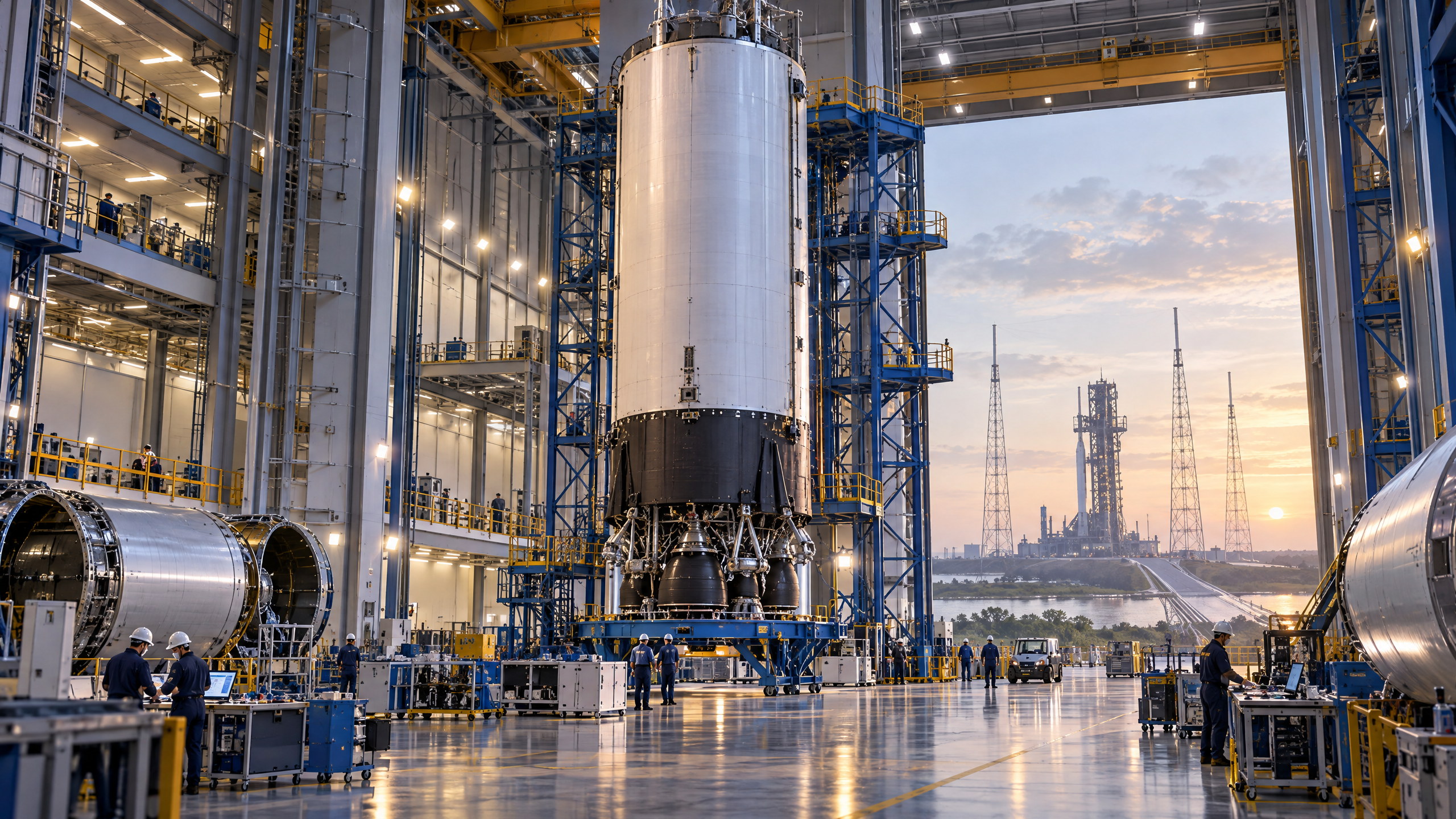
Blue Origin says it has begun a $330 million expansion of its Rocket Park manufacturing campus in Florida to support a higher-capacity version of its New Glenn rocket. The project is focused on production of the vehicle’s 9x4 second stage, not on adding launch pads by itself. The company is targeting completion in summer 2027. [1] [2]
Rocket Park is a 1.37-million-square-foot manufacturing campus near NASA’s Kennedy Space Center, according to Blue Origin. The company says the added capability could support production of as many as 150 upper stages a year once complete. That is a stated maximum capacity, not a forecast that Blue Origin will actually build or launch that many vehicles annually. [1]
A factory is only one part of the launch system
The company’s broader ambition is to fly New Glenn several times a week by the end of the decade. That target depends on more than upper-stage output. Blue Origin is also building customer and vehicle integration facilities, working on launch infrastructure and planning additional pads. The company has filed to increase the permitted launch rate at Launch Complex 36 from 12 to 50 launches per year; that is a request, not an approved change. [1] [2]
The distinction matters because rockets move through a chain of production, integration, testing, launch-site processing and regulatory approval. A higher factory ceiling can remove one bottleneck, but it does not by itself establish a flight schedule. Blue Origin’s press release describes multiple pieces of a Florida buildout, while Reuters likewise frames frequent launches as a goal for the broader system. [1] [2]
Blue Origin’s latest plan also sits alongside operational work at its existing facilities. The company says it is restoring Launch Complex 36 after an earlier anomaly. Reuters has reported that the rocket was grounded after a May launchpad explosion and described a second-stage issue during an April mission. These events underline that manufacturing scale-up and launch reliability must progress together. [2]
For the space industry, the announcement is a signal of investment in heavy-lift launch capacity. Its eventual effect will depend on whether the new production line finishes on schedule, the rest of the Florida infrastructure comes online, and New Glenn can sustain a higher flight rate. For now, the numbers are plans and capacity targets—not a record of achieved launches. [1] [2]